
Historical Encounters strives to maintain a high academic quality, and utilises a “double blind” peer review process where the anonymity of both authors and reviewers is maintained throughout and beyond the peer review process. It should be noted, that despite all efforts of the editorial team, it may still be possible for a reviewer to discern an author’s identity by the nature of the content, or writing style, given the specialised nature of the field.
Each submission is initially examined by the section editor to determine if it fits within the scope of the journal. Submissions which are deemed appropriate to the scope of the journal will then be anonymised and distributed to reviewers for blind appraisal. The reviewers are selected based on their competence in the specific field with which the submission deals, or based on their solid general competence within the wider field of historical consciousness, historical cultures, or history education.
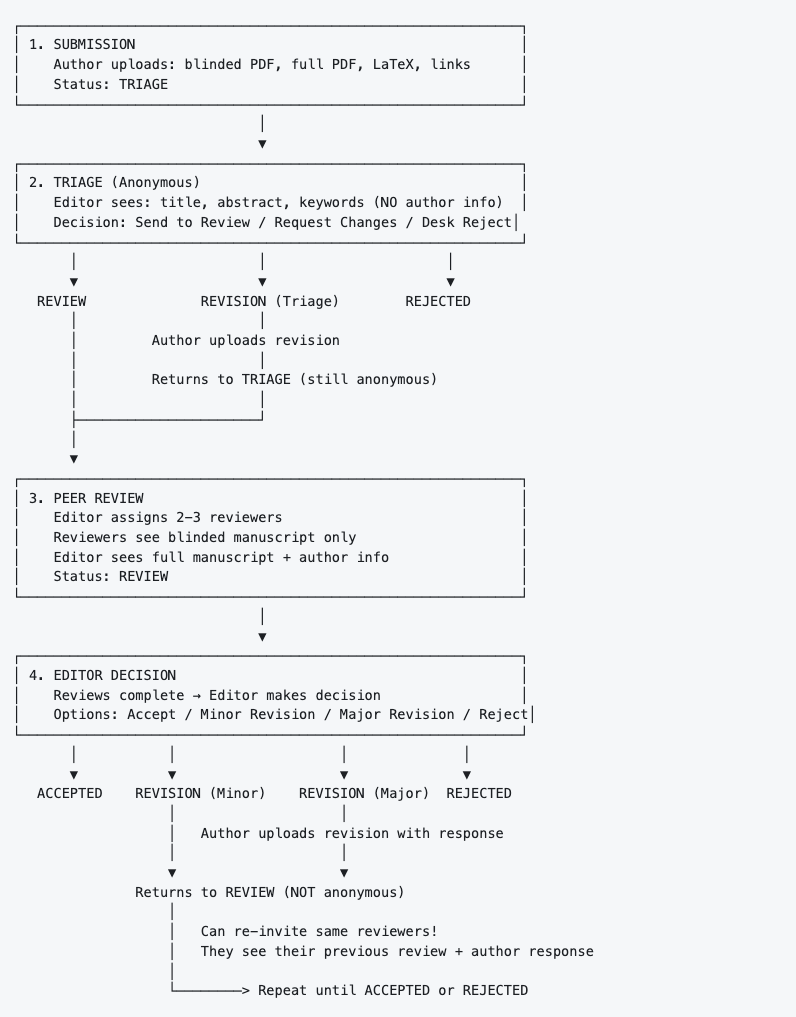
The Manuscript Journey using the Gauge Freedom Journal Workflow copied from GitHub: gaugefreedom and provided below:
Review Criteria
Reviewers are asked to comment on the strengths and weaknesses of submissions using the following criteria:
- Clarity & Significance: The paper clearly states a focused research question, problem or thesis and explains why it is important to the field.
- Engagement with Relevant Literature: The work demonstrates thorough knowledge of existing scholarship and situate sits argument effectively within current debates.
- Theoretical and/or Methodological Rigor: The methods (theoretical, interpretive, historical, qualitative, quantitative, or mixed) are appropriate to the research question and applied rigorously.
- Strength and Coherence of Argumentation: The argument is logically structuredm internally consistent, and develops convincingly from evidence and analysis.
- Originality or Novelty: The article demonstrates originality and intellectual novelty in its concepts, perspectives, or provocations, offering meaningful new contributions to existing scholarship.
- Style and Quality: The paper is clearly written, well organized, accessible to an international audience, and maintains a respectful, scholarly tone.
The Editors rely heavily on the judgements of reviewers, but are not bound by them. The Editor’s decision about publication, revision, or rejection is final. Appeals to an editor’s decision will only be received on specific grounds. See our Appeals Policy for more information.
Possible Reasons for Rejection of a Manuscript
Some of the common reasons manuscripts are rejected include:
- The author has submitted their paper to the wrong journal: it doesn’t fit the Aims & Scope or fails to engage with issues addressed by the journal.
- The manuscript is not a true journal article, for instance it is too journalistic or clearly a thesis chapter.
- The manuscript is too long or too short.
- There is poor regard of the journal’s conventions, or for academic writing in general.
- Poor style, grammar, punctuation or English throughout the manuscript.
- The manuscript does not make any new contribution to the subject.
- The research has not been properly contextualized.
- There is a poor theoretical framework used.
- The manuscript is poorly presented.
- The manuscript is libelous or unethical.